Last updated: September 30, 2026
Of all the documents in a Schengen visa file, the travel itinerary is the one applicants put the least thought into, and the one that can quietly decide the outcome. A bank statement shows you can afford the trip. A cover letter says why you want to go. The itinerary is where the visa officer checks whether your story holds together: do your dates match your flights, do your hotels cover every night, and does the pace of the trip look like something a real person would do?
This guide covers what to include day by day, how to build the itinerary step by step, how to handle flights and hotels without paying for everything upfront, and the mistakes that most often trigger a refusal.
What the itinerary is actually for
Consulates ask for a day-by-day plan because the itinerary is evidence of purpose, one of the core legal requirements for a short-stay visa. All 29 Schengen states apply the same visa rules, and those rules require you to show a credible reason for entering the area and a credible plan for leaving it (see the European Commission’s Schengen visa policy pages for the framework). France’s official France-Visas portal asks applicants for a “reservation confirmation of an organised trip or any other document describing the planned programme.” Your itinerary is that document.
Think of it as the spine of your application. Your flight reservation, hotel bookings, travel insurance, cover letter, and the dates on your application form all attach to it. When every document tells the same story, the officer’s job is easy. When dates clash or nights go missing, the file looks assembled from pieces that do not belong together, and that is when doubts begin.
The five checks a visa officer runs on your itinerary
Refusal letters and consulate guidance point to the same five checks, applied to nearly every tourist file.
1. Is every day accounted for?
From the day you land to the day you fly home, each date should show where you will sleep that night. Hotel confirmations must cover the entire stay with no gaps. A missing two-night stretch in the middle of a 12-day trip is one of the most common itinerary failures consulates flag, and it is usually enough to trigger questions about the whole plan.
2. Do the dates match everywhere else?
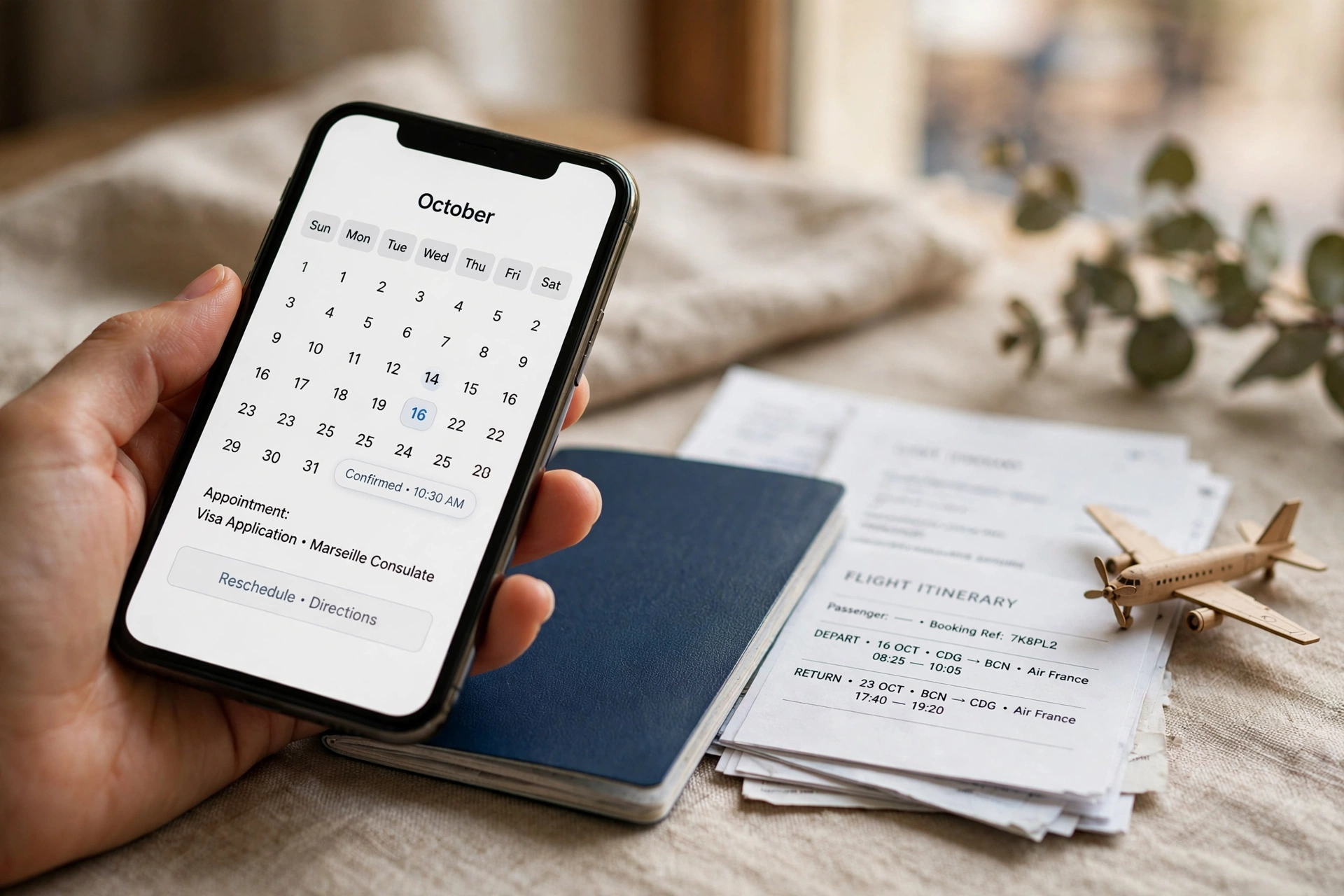
The dates on your itinerary must agree with your application form, flight reservation, hotel bookings, and insurance policy. If your form says December 20 to 27 while your hotel starts December 21 and your flight leaves December 19, you have three different trips on paper. Officers read these documents side by side, and contradictions feed the suspicion that the trip is not real.
3. Is the pace believable?
An itinerary that crams six countries into ten days reads as fantasy, not planning. For a 10 to 14 day trip, two or three countries is a believable rhythm. The officer is testing plausibility: would a genuine tourist move this fast, and would they actually enjoy it? Slow the trip down and it becomes credible.
4. Do the activities fit the traveler?
A sightseeing plan should look like something the person applying would actually do. You do not need an hourly schedule. A few specific, plausible activities per day is enough. “Visit the Eiffel Tower, evening Seine walk” is credible. Twenty attractions in a single day is not.
5. Does the trip fit the money?
Officers compare the cost of your trip against your bank statements. A three-week grand tour on a modest balance raises the same question as a luxury hotel booking on a small salary. Including rough daily costs lets the numbers visibly add up, as the budget section below shows.
What goes on each day: the six columns
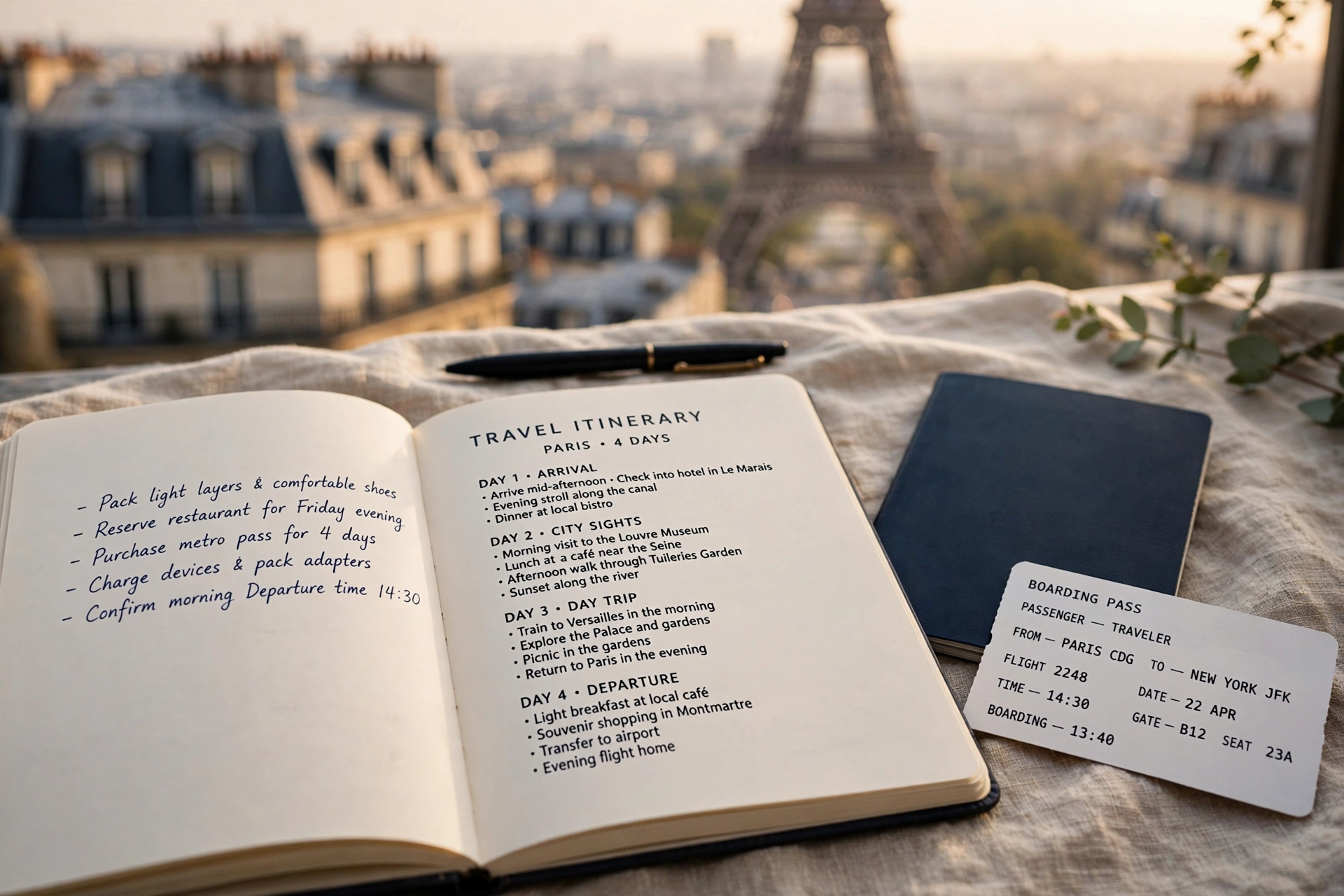
A clean table is the easiest format to read, and many applicants build it in a simple spreadsheet. Each row is one day, and each row needs six pieces of information: the exact calendar date; the city and country (name both, since this shows your route clearly); the transport for that day, whether a flight number, a train route, or a sightseeing day with no travel; the hotel for that night, matching your booking confirmation exactly; two to four specific activities; and an optional notes column for things like “day trip returns to base city.”
Keep the whole document to one or two pages.
Building it, step by step
Step 1: Fix your dates and your anchor country
Choose your entry and exit dates first, because everything else hangs off them. Then work out your main destination, the country where you will spend the most nights. That country decides which consulate you apply to. If two countries tie, apply to the one you enter first.
Step 2: Sketch the route before the details
Draw the trip at country level first: for example, 5 nights in France, 4 in the Netherlands, 2 in Belgium. Give big cities at least two or three days each and keep travel days realistic. A day with a morning train, an afternoon walking tour, and an evening museum visit is full. Do not stack three cities into it.
Step 3: Fill in the hotels
Assign a hotel or host address to every single night. This is where gaps appear, so count nights explicitly: a 10-day trip is 9 nights. If you are staying with family or friends, note their address and attach the invitation letter. The itinerary should still show the nights.
Step 4: Add the transport between stops
For each move between cities or countries, name the mode of transport. You do not need to buy intercity train tickets for a visa application. Naming the route, like “Paris to Amsterdam, high-speed train, about 3h20,” shows the plan is thought through. Your flight reservation covers the flights.
Step 5: Write the activities
Add two to four concrete activities per day. Specificity separates a real plan from a template: “morning at the Louvre, afternoon walk through the Tuileries, evening along the Seine” is believable, while “city tour” is not. Include one or two slower days. Rest days and open afternoons make the trip look human.
Step 6: Add a short budget line
A one-page cost estimate for accommodation, food, local transport, and activities shows you have thought about money and that your funds cover the trip. Honest ranges beat exact figures. There is a worked example below.
Step 7: Cross-check every document against it
Go through your whole file with the itinerary in hand: application form dates, flight reservation dates, every hotel check-in and check-out, insurance start and end dates, and your cover letter. They must all say the same thing. For longer trips, the European Commission’s short-stay calculator is the official tool for confirming your stay fits the 90-days-in-any-180 rule.
Flights and hotels without paying in advance
The question every applicant asks: do I have to buy flights and book non-refundable hotels before the visa is approved? No, and you should not. Paying thousands for a trip that might be refused is an unnecessary risk, and consulates know it. What they expect is a verifiable flight reservation (sometimes called a flight itinerary or dummy booking) and hotel bookings, ideally with free cancellation.
Three rules keep this safe. First, the flight reservation must be verifiable: it should carry a real booking reference that can be checked, because officers do check. Second, hotel bookings should be refundable or pay-at-property, so a refusal costs you nothing to cancel. Third, never submit a forged or obviously fake document. Falsified documents are recorded in the Visa Information System shared by all Schengen states, and a forgery flag can damage future applications for years. A reservation you could actually travel on is acceptable. A document you invented is not.
On timing: apply no earlier than six months before your trip and no later than 15 days before departure. Booking refundable hotels early gets you better prices while keeping the risk near zero. Our complete Schengen tourist visa guide covers the full document checklist and the application timeline in more detail.
A realistic 10-day sample itinerary
Here is what a believable 10-day plan looks like: three countries, a sensible pace, rest built in. Consulates see thousands of identical templates, and yours should reflect a trip you would genuinely take.
- Day 1 — Arrive Paris, France: land at Charles de Gaulle in the afternoon, check in to a city-center hotel, evening walk along the Seine.
- Day 2 — Paris: morning at the Louvre, afternoon through the Tuileries Garden, dinner in the Latin Quarter.
- Day 3 — Paris: day trip to Versailles by train (palace and gardens), return to Paris in the evening.
- Day 4 — Paris to Amsterdam: high-speed train to Amsterdam (about 3h20), check in, evening canal-side walk.
- Day 5 — Amsterdam, Netherlands: Rijksmuseum in the morning, Van Gogh Museum in the afternoon, evening canal cruise.
- Day 6 — Amsterdam: slower day, Jordaan neighborhood and local markets, rest in the afternoon.
- Day 7 — Amsterdam to Brussels: intercity train to Brussels (about 2 hours), check in, Grand Place and old town in the evening.
- Day 8 — Brussels, Belgium: Atomium and Mini-Europe in the morning, chocolate and waffle tasting walk in the afternoon.
- Day 9 — Brussels: day trip to Bruges by train (under an hour each way), return to Brussels for the night.
- Day 10 — Depart Brussels: morning at leisure, transfer to Brussels Airport, fly home.
Notice what this does: every night has a city, the longest stay (Paris, 3 nights) determines the consulate, travel days are realistically short, and one slower day makes the rhythm human. Nine nights, three countries, zero red flags.
A budget page that supports your bank statements
A simple cost estimate is the decision aid most applicants skip. It shows the officer that the trip is financially coherent and that your savings cover it. The example below uses typical 2026 mid-range costs for the 10-day trip above.
- Accommodation: €90 per night x 9 nights = €810
- Food: €40 per day x 10 days = €400
- Intercity transport: 2 train journeys, about €60 each = €120
- Local transport and activities: €30 per day x 10 days = €300
- Travel insurance: about €40 for 10 days
- Estimated total: about €1,670
Now compare that total against your bank balance. If your statements show a steady balance well above the trip cost plus your normal expenses, the file reads as affordable. If the total is close to everything you own, reconsider the trip length or the route before you apply. This one page answers the affordability question before the officer asks it.
Five mistakes that get itineraries rejected
1. The impossible pace. Five countries in seven days, or a new city every single night. Officers know the map. If your plan defies geography or basic fatigue, they assume the documents were assembled for the application rather than for a real trip.
2. Dates that disagree. The application form, flight reservation, hotel bookings, insurance policy, and cover letter each say something slightly different. Pick one set of dates and copy it everywhere. This single check catches more files than any other.
3. Missing nights. A gap of even one or two nights with no hotel and no explanation invites the question of where you planned to sleep. If you genuinely have an unbooked night, explain it. Better to have none.
4. Copy-paste templates. Itineraries lifted wholesale from the internet, with attractions you clearly have no interest in, are easy to spot. Use any template only as scaffolding and rewrite it around a trip you would actually take.
5. Activities that ignore the season. Planning mountain excursions in January or Christmas markets in July tells the officer the itinerary was written without checking a calendar. Match your activities to the months you are actually traveling in.
The consistency check before you submit
Before your file goes to the visa center, sit with every document and run this audit. It takes twenty minutes and it is the highest-value time in the whole application.
- Entry and exit dates are identical on the form, itinerary, flight reservation, and insurance policy.
- Every night of the trip has a named hotel or host address, with bookings covering the full stay.
- Hotel names on the itinerary match the booking confirmations exactly.
- The longest stay is in the country whose consulate you applied to.
- Insurance covers at least €30,000, all Schengen states, and the entire trip period including travel days.
- The cover letter describes the same trip the itinerary shows: same countries, same dates, same order.
- The trip cost is comfortably below your available funds, and the budget page says so.
Frequently asked questions
Does the itinerary have to be in a specific format?
No consulate prescribes a format. A simple table with date, city, transport, hotel, and activities is the most readable option and the one officers are used to seeing. A neat spreadsheet printout beats a long narrative paragraph.
Can I change my plans after the visa is approved?
Yes, within reason. Plans shift, and a different hotel or a swapped day trip is normal travel. What should not change is the substance the visa was granted on. Dramatic changes, like a different country entirely or a much longer stay, can cause problems at the border.
Do I need to book activities and tours in advance?
No. You do not need paid tour bookings or attraction tickets. Naming what you plan to do is enough. Booking a few things in advance is fine if you want to, but keep everything refundable until the visa is in your passport.
What if I am visiting family instead of sightseeing?
Your itinerary looks different but the same rules apply: dates of arrival and departure, the host’s address for each night, any side trips you plan, and the invitation letter as your accommodation proof. Note the relationship and keep the plan realistic. The same consistency checks apply.
How detailed should each day be?
Two to four specific activities per day is the sweet spot. Less looks vague, more looks invented. A mix of planned days and one or two open days reads as a genuine holiday rather than a performance.
Should my itinerary mention every country I will pass through?
Name every country where you will spend a night, because each one counts toward your stay and confirms your route. Brief transit, like a train passing through without stopping, does not need its own entry. Any overnight stay does.
A good Schengen itinerary is not a creative writing exercise. It is a coherent, checkable record of a real trip: consistent dates, a believable pace, a hotel for every night, and costs your bank statements can support. Build it honestly, cross-check it against every other document in your file, and it will do exactly what it is meant to do: make the visa officer’s decision easy.